
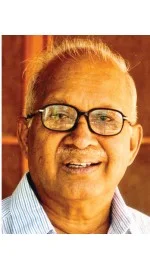
M.P. Parameswaran, a former CPI(M) theoretician and science educator, passed away on August 11, 2026, at his residence in Thrissur, Kerala. He was 91.
Parameswaran was a nuclear scientist. He earned his PhD in nuclear engineering in Moscow in 1965, and was employed at the Bhabha Atomic Research Centre (BARC) from 1957. He quit his job in 1975 to become a full-time social activist.

He was one of the architects of the renowned science education movement, the Kerala Sasthra Sahithya Parishad (KSSP), founded in 1962. KSSP spearheaded statewide science education and environmental education campaigns. KSSP was the leading critic of the Silent Valley hydroelectric project — a campaign that led Prime Minister Indira Gandhi to intervene in 1980 and halt work on the project. Silent Valley, a rain forest with many endangered fauna, was declared a national park in November 1984. KSSP’s Save Silent Valley campaign created a new ecological consciousness in Kerala society.
He championed the Total Literacy Campaign — beginning with the Ernakulam district campaign of 1989-90 — which drove Kerala’s literacy rate up sharply. In April 1991, Kerala was declared India’s first fully literate state.
Known for his highly quantitative thinking, he was said to make mathematical estimates before any project was initiated. His followers recount that before the ‘Parishad Stove’ project, he calculated how many trees would be saved if the controlled-combustion stove replaced the standard stove throughout Kerala. Although not a great orator, he was skilled at small-group discussions and was adept at drawing talented young people to volunteer for organisations like KSSP for large-scale projects. He had a knack for rapidly transitioning proof-of-concept projects to massive pan-state interventions.
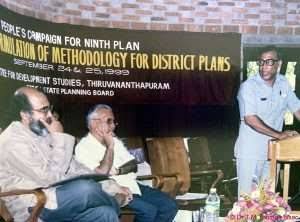
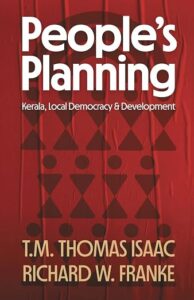
One of his most remarkable achievements was the People’s Planning Campaign of 1996, in which local communities were systematically trained to plan for the appropriate allocation of local-body resources. This was spearheaded by his protégé, Thomas Isaac, who went on to become Kerala’s finance minister.
The People’s Planning Campaign led to the devolution of roughly 35-40% of the state government’s plan resources to local panchayat raj bodies. This became the bulwark of Kerala’s development model from then on. Kerala is perhaps the most successful state in India to have implemented decentralised local governance under the 73rd Constitutional Amendment Act of 1992.
.
Kerala’s successful grassroots campaigns — including its response to the COVID-19 pandemic, the Nipah outbreak, and relief efforts after the devastating 2018 floods, which displaced about 10% of the state’s population into relief camps — were all effected through this local-body governance architecture.

A prolific writer, he was both a theoretician and an executor of ideas. In the 1990s, he developed the concept of the “Fourth World,” rejecting the hyper-productivist models of development followed by both capitalist nations and the communist model adopted in the USSR. He was concerned that both models damaged ecology and argued that development should be decentralised and planned from the bottom up.
However, the concept triggered an intense ideological war within the CPI(M) that ultimately led to his expulsion from the party in 2004. Hardline Marxist intellectuals such as M.N. Vijayan argued that the ‘Fourth World’ is actually a capitulation to the Western NGO-based ‘ad hoc’ development activity that is designed to scuttle revolutionary fervour in 3rd world countries.
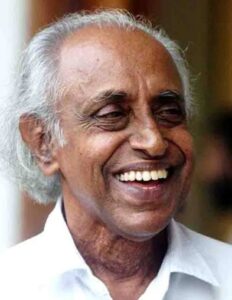
While Parameswaran was expelled from the party, many of his colleagues and followers remained within it and went on to implement Parameswaran’s ideas in Kerala’s governance step by step. The most successful of these was the People’s Planning Campaign led by Thomas Isaac.
The Kudumbashree programme — a grassroots women’s empowerment and poverty-alleviation initiative launched in 1998 — also carries the imprints of Parameswaran’s vision of locally rooted development. The programme provides employment to women through self-help-group-based enterprises. Kudumbashree now has close to 4.5 million members. Kerala’s poverty rate fell from around 60% in the 1970s to about 11% by 2011, a decline in which Kudumbashree played a significant part. Today, Kudumbashree functions almost as an arm of government, enabling rapid, locally effective relief and development measures. During the COVID-19 pandemic, it ran community kitchens across the state, preventing starvation among migrant labourers and those in COVID quarantine.
On November 1, 2025, when then Kerala Chief Minister Pinarayi Vijayan declared Kerala free of extreme poverty, he was, in effect, declaring the success of the vision that M.P. Parameswaran had theorised as the “Fourth World” and helped execute through numerous statewide initiatives — the literacy drive, the People’s Planning Campaign, and the Kudumbashree movement. Without this development architecture, none of Kerala’s landmark achievements could have been possible.
In many ways, unbeknownst to most, M.P. Parameswaran was a towering figure who changed Kerala’s development trajectory. He leaves behind a legacy that is understated but embedded in what Kerala has become — a welfare state with an intellectual and political sensitivity distinct from the rest of the country. Indeed, M.P. Parameswaran, the diminutive theoretician and grassroots executor, had built a “Fourth World” unlike any other.
Views: 133
The article is written in a very simple and humble manner, making it easy for everyone to understand. The gist of the interconnected efforts to alleviate poverty in Kerala is well captured, with significant grassroots-level action plans explained through a thoughtful recollection. One can clearly understand the sequencing of change towards development through the narration, even without having prior knowledge of the theory of change.