

1/4

I bought Edna Fernandes’s ‘The Last Jews of Kerala’ in a nondescript shop selling Jewish curios in Fort Kochi’s Jew Town.¹ Published in 2008, the book tells the story of then fast depleting population of the Jews in the city of Cochin in Kerala in a journalistic, narrative style. The author tried to capture the forces that drives the dwindling numbers of the community. But I think there is more to tell on the story than the a regional trivia of an ancient religion. It would make up for yet another ‘vocabulary’ to understand the conflicts that followed.
In this article I would foreground the story of ‘Last jews of Kerala’, to tell the history of this ancient community from their exit from West Asia to their eventual founding of the state of Israel and ensuing conflicts. I would connect this with developed of Abrahamic religions, their conflicts in a ‘pagan world’, and the development of the so-called Judeo-Christian world order.
The Jews of Kerala are one of the oldest Jewish communities in the world. The first contact of Kerala with Jews is described in Biblical accounts where merchants docked at Kerala’s harbour for procuring spices and treasures like ivory. But the first wave of immigrants to Kerala is traced to 70 CE when the Roman’s sacked the Second Temple in Jerusalem.² The earliest settlements were in Calicut and Quilon, while the major settlement was in Kodungalore ( Angliced Cranganore). Kodungalore was a major port in ancient times, with merchants from Rome and Arabia trading for spices and other exotic products of the East.
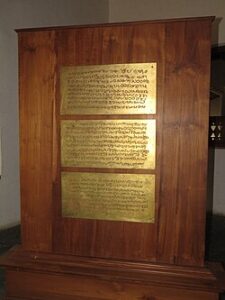
Copper Plate and Joseph Rabban, the ‘Merchant King’
Around 1000 AD, the Chera King, Bhaskara Ravi Varman, issued a copper plate edict granting special privileges to Joseph Rabban ( Issuppu Irappan in old Malayalam) a Jewish trader-aristocrat.³ This includes an autonomous princely status with rights to employ weapons, remission of trade duties, rights of Anjuman trade guild and many aristocratic rights like day lamb, palanquin, trumpet etc. The 72 privileges so granted was following a war council incident to Chera-Chola war where Rabban agreed to assist the king. This princely privilege, honoured by Kochi’s subsequent kings, was unique in that none of the Jews settled elsewhere in India achieved in their stay. The privilges included leadership rights over the merchant community in Anjuvannam, tax exemptions, rights for tolls and revenue and permission to use ceremonial umbrellas, lambs and trumpets associated with Princely stature. The charter written in old Malayalam Vattezhutthu is known as the Jewish copper plate or Cheppedu. It is described as the ‘Magna Carta of the Jews of Kerala, signifying Jewish rights and influence in the royal court of the region.
In 1341, there was a massive flood involving the river Periyar, obliterating the Kodungalore harbour, at the same time creating a smaller harbour in Kochi ( the word Kochi came from Kochazhi, meaning ‘small estuary’). As the importance of Kodungalore waned, the Jews started moving to Kochi, the new regional trade post.
Meanwhile, in 1498, the Portuguese under Vasco de Gama discovered the sea route from Europe to India. They landed in Calicut, 200km north of Kochi. Gama wanted to secure an exclusive trade agreement, but Zamorin, the ruler of Calicut, who had a flourishing trade with Arabs and other merchant communities, did not agree.
Gama returned to Portugal and reported his experience with Zamorin. In 1500, Portugal sent an armada of 33 ships to Calicut commanded by Pedro Alvares Cabral. Cabral again demanded exclusive trading rights. Although preferential treatment was not given, Zamorin granted Cabral permission to set up permanent trade post called ‘factories’.
Cabral’s trade went on smoothly for few months, but ran into trouble with the Arab-Muslim trade system that was already established in Calicut at that time. In December 1500, there was attack on his factory by a mob involving Muslim merchants and dockworker in which 50-70 Portuguese killed. Cabral retaliated to the attack. This involved seizing Arab merchant ships, execution of crew and bombarding of Calicut harbour. With this Cabral abandoned Calicut and allied with Zamorin’s rival king in Kochi. This decision was apparently done on the advice of Cabral’s Jewish-turned-Christian advisor Gaspar da India.
Kochi King agreed for treaty as he was fearful of the local hegemony of the Zamorin. Portuguese set garrisons and factories in Kochi. Zamorins, on the other hand, was allied with Arabs and wanted to expand their territory beyond Calicut. This led to clashed with Jews in Kodungalore. In 1524, a fight regarding a trade issue, led to death of a Muslim man. In retaliation. Muslims traders ( knowns as Moors) attacked Jewish settlements in Kodungalore, burning houses and synagogues. After this attack, Jews started moving out of Kodungalore.


By 1566, most of the Jews left Kodungalore. Many of them reached Kochi and established the Jew Towns of Mattancheri and Kochi. However, the Portuguese, who had by the time become the defacto trading ‘overlord’ of Kochi did not have overtly cordial relationship with the Jews. Portugal was already a kingdom that is known to be intolerant to Jews. This was incident to the reconquest of Iberian peninsula by Catholic kings and subsequent conversion forced Muslims and Jews to Christianity. There were widespread suspicion that converted Jews secretly practised Judaism. In March 1492 Jews and Muslims were expelled from Spain by a Royal decree. In December 1496 they were expelled from Portugal. The expulsion of ‘heretics’ like Jews and Muslims were one of the conditions of marriage negotiation between Portuguese king Manuel I and Spanish Princess Isabel. However, the Dutch city of Amsterdam was flourishing centre of Jewish community involved in trade and finance. Portuguese in Kochi imposed arbitrary taxation and was apparently contemptuous and discriminatory towards the Jews. During the Portuguese-Dutch hostility, the Portuguese suspected that Jews supported the Dutch.

In 1662, Portuguese attacked the Jewish quarter in Kochi, plundering housing and destroying the so-called Pardeshi Synagogue. This was reported in retaliation for Jewish assistance to the Dutch. In 1663, however, the Portuguese surrendered to Dutch assault and withdrew to Goa. From 1663 to 1795, the Dutch maintained a settlement in Kochi, forming a major centre of trade in Malabar.
The fate of the Kochi Jews changed with the arrival of Dutch. They benefited from the Dutch network, especially fostered through the Jewish communities in Europe. This continued until 1767 when British replaced the Dutch as the colonial power in Kochi.⁴
Before the Jewish migration from Kodungalore to Kochi, there were another wave of immigrants who joined the Jewish communities in Kodungalore. They were Jews from the regions of modern Spain and Portugal fleeing religious persecution from the conversation and/or inquisition catholic Christian regions. These were light coloured Jews of European racial admixture. These, Sephradic Jews, initially intermingled and intermixed with the darker complexioned Jews of Kodungalore. But soon a racial segregation based on skin colour emerged between the original ‘black’ Jews and the light coloured ‘white’ Jews. Probably, this could have been accentuated by their contact with the European colonists, as the Sephardic Jews could better utilise their connections in Europe to develop trade relationship that aligned with colonial empires. Knowledge of Jewish tradition and rites .The older ‘black Jews’ were more of a West Asian ancestry and resembled the native population of Kerala than the Jews who immigrated from Southern Europe.

The synagogue in Ford Kochi known as the ‘Pardeshi’ Synagogue was built by Jews of European ancestry. They tend to discriminate ‘black’ jews or the Malabari Jews, who were not allowed full congregational membership in the Synagogue. They were not counted as men who could form the prayer quorum ( called Minyan) required for communal prayer. In addition to the Malabari Jews, there were another group of Jews known as Meshuchrarim Jews. They were those who were the descendants of slaves who came with the European Jewish immigrants. They were mostly from mixed African European descent. They were discriminated even more. Meshuchrarim were required to sit on the floor of the entrance hall, away from the main congregation. They did not receive the customary calls to read passages from Torah during the prayer congregation. They were not allowed burial in the main cemetery. Couples crossing the ‘caste’ boundaries were refused weddings in the synagogue. The discrimination continued for centuries until a leader emerged from the Meshuchrarim community.

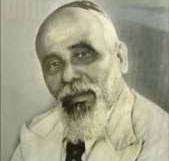
‘Jewish Gandhi’ Abraham Barak Salem
Abraham Barak Salem, born in 1882, was the first University graduate from the Meshuchrarim community. He went on to acquire a law degree and practiced as a lawyer in the Cochin Chief Court in Ernakulam. He began political activity about the age of 25, involving in workers’ causes and was soon involved in Indian National Congress’ activities. He was the President of Mattanchery Congress Committee. He served in Cochin’s Legistative Council, a representative system within the Kochi princely state. He attended the 1929 Lahore Congress of INC where the call for complete independence from the British was adapted. He met MK Gandhi in 1925, and got familiar with Gandhi’s Satyagraha protest methods. From 1930 onwards he adapted Gandhian methods to protest against Pardeshi Synagogue’s discriminatory practices. This included sit-ins and refusal to follow the discriminatory seating arrangement in the Synagogue, boycott of discriminatory prayer meetings, and alternative prayer services in his home.
Salem’s protest led to generate a group of young progressive White Jews in support of Black Jews. They in turn adapted Salem’s ‘civil disobedience’ movement. They refused to partake in the Simhat Torah processions, where they were supposed to carry heavy Torah scrolls to the Synagogue.⁵ This internal rifts among the White Jews led to a series of concessions.
The first concessions from discriminatory practice happened in 1932 when Meshuchrarim were allowed to sit in rear benches and allowed to use the cemetery along it back wall. In 1942, Salem was permitted to recite the maftir, the concluding portion of Torah. In 1952, Salem’s son Balfour Salem married Baby Koder from a White Jew family. However, by the 1960s there was mass immigration of Jews from India to Israel. The numbers of Jews in Kochi slowly dwindled, and by late 1980s the number of people attending the Pardesi Synagogue was so low that they could not get the quorum of ten male members to conduct the regular Sabbath. By 2006, religious services in the Synagogue depended on visiting Jews to complete the quorum.
Salem was called ‘Jewish Gandhi’ for his work against discriminatory practices in Kochi Jewish community. He was an active supporter of the project of Israel state. He promoted Aliyahm, the Jewish migration to Israel. He died in Kochi in 1967.
The discrimination among Kochi Jews were represented to the rulers of Kochi multiple times. However, they did not heed. In fact, the local Diwan instructed Black Jews to ‘walk submissively’ before the White Jews as a penalty to their protests.⁵ The Black Jews asked for permission, the Diwan issued a decree that ‘no prayer services should be conducted by the group with ‘impurity’ in the Synagogue’. Apparently, the caste system prevalent in Kerala was juxtaposed with the colour distinction of Jews of European ancestry.
The racial discrimination in Kochi was not without objection from within the Jewish community. The Halakha or the body of Jewish religious laws does not prescribe any racial categorisation. In c1520 Rabbi David ben Solomon ibn Abi Zimra, in response to a petition by Cochin Jews, stated that intermarriage between Meshuchrarim and Pardeshi Jews is allowed and that Meshuchrarim Jews have equal rights in the synagogue. In 1600, rabbi Jacob de Castro reaffimed David Solomon’s permission for intermarriage. In 1882 Rabbi Phanizel, the chief Rabbi of Jerusalem ruled that Mechucharim Jews should have equal religious privileges. In the 20thcentury, Rabbi Lousi Rabinowitz wrote in his book Far East Mission that the discrimination in Kochi is similar to racial apartheid in South Africa.

The exact origin of the racial discrimination among Kochi Jews is not clear. The migrants of Sephradic origin boasted of their ‘pure’ Jewish heritage and their knowledge of Jewish religious practices. They considered their lighter skin tone an indication of their ‘pure’ lineage. They considered Malabari Jews as offsprings of ‘slave converts’.
Pardeshi Jews had greater influence over the King of Kochi. The King gave them a prime spot near palace to built their Synagogue. The white Jews connections with the Dutch trading network buttressed their influence over the King. The appeal of the Malabari and Mechurism Jews for intervening on the segregation practices were ignored by the Kochi royal authorities.
The Dispute over the Copper Plate
While the earliest dates of arrival of the Pardesi Jews is the late 15th century, the copper plate issued by the Chera King to the Jewish merchant Joseph Rabban is displayed in Paradesi Synagogue. The exact circumstances in which it reached the hands of the White Jew community in Kochi is not known. But the oral tradition among Malabari Jews states that it was borrowed by Pardeshi Jews to display them to important European visitors. Allegedly a British visitor took the original from the Pardeshis, and sent back copies instead. Malabari Jews refused to accept the copies, while Pardeshi Jews displayed the copy in their Synagogue in Kochi.⁶
As Rabban provided a royal recognition to the Kerala Jews, loss of the Copper plates is considered a burning issue that cuts at the very legitimacy of their existence. The Malabari Jews consider the Copper Plate affair as a fraud the Pardeshi Jews committed, while latter consider it as the demonstration of their claim to the true legacy of Jews in Kerala. From the Pardeshi perspective, Zakkai family is claimed to have their origin in Kodungalore. They merged with the later Sephardic and Aleppo Jews to form the ‘white jews’ community. There are historic records that the Plates come to the possession of Ezekiel Rahabi who was a chief merchant and a diplomatic intermediary for the Dutch East India Company in Cochin.⁷ His family migrated from Aleppo in present day Syria ( the Levant area). How the Plates reached his possession is not clear. But there is a communication that he wrote to a Jewish merchant and banker, Toias Boas of Hague regarding the possession of the plates. In this letter Rahabi mention about the existence of forty families of ‘White Jews’, and 300 families of ‘Black Jews’ dispersed in various parts of Cochin and adjacent regions like Mala and Anjikaimal.⁸
Rahabi claimed in his letter that Jews of Malabar descended from Jews who had fled the Roman destruction of the Second Temple in Jerusalem c 70 AD.
The significance of this claim and its reference in the letter to a compatriot can be understood only when one understand the story of the Jews as a community with their claimed origin in West Asia.
End of 1/4
References
- Fernandes, Edna. The Last Jews of Kerala. Penguin Viking, 2008.
- Gamliel, Ophira. “Back from Shingly: Revisiting the Premodern History of Jews in Kerala.” The Indian Economic and Social History Review 55, no. 1 (2018), 53–76. Full text. eprints.gla.ac.uk
- Gamliel, Ophira. “Jewish Maritime Networks in Old Malayalam Inscriptions.” In Judaism in South India, 849–1489: Relocating Malabar Jewry, 31–62. Arc Humanities Press, 2023. DOI. Judaism in South India, 849-1489
- Cochin Port Authority. “Evolution of Cochin Port.” Historical chronology, entries for 1500, 1503, 1663, and 1795. Full text. www.cochinport.gov.in
- Katz, Nathan, and Ellen S. Goldberg. “The Sephardi Diaspora in Cochin, India.” Jewish Political Studies Review 5, nos. 3–4 (1993), 97–140. See especially pp. 124–125 on the Diwan’s intervention and pp. 128–130 on Abraham Barak Salem and his supporters. Full text. jcpa.org
- Thurston, Edgar, and K. Rangachari. “Jew.” In Castes and Tribes of Southern India, vol. 2. Madras: Government Press, 1909, p. 463. Digitised volume. rarebooksocietyofindia.org
- Fischel, Walter J. “Cochin in Jewish History.” Proceedings of the American Academy for Jewish Research 30 (1962), 37–59, especially pp. 56–57 on Ezekiel Rahabi and the copper plates. Full text. ProcAmAcadJRes 30:37‑59 (1962)
- Fischel, Walter J. “The Exploration of the Jewish Antiquities of Cochin on the Malabar Coast: A Historical-Critical Survey.” In the Cochin Synagogue Quatercentenary commemorative volume, 1968.
Next: The Story of the Jews
Views: 47